
When sourcing lithium ion battery cells for pack builds, many integrators only look at capacity and price upfront. But mechanical assembly details, battery management system configuration, safety thresholds and storage handling rules directly determine the long-term reliability of your final product. Drawing from customer Stuart’s real EV battery retrofit project, we put together this practical field guide for anyone working with EVE M21‑V1.2 59Ah cells.
Always stick to official battery safety parameters when setting up your BMS: • Max normal charging voltage: 4.3V; absolute upper safety limit: 4.35V • Discharge cut-off voltage should be adjusted according to ambient temperature • Safe operating temperature range: -31℃ to 60℃. Do not operate cells outside this range.
The cell has passed GB38031‑2020 abuse tests including overcharge, short circuit, crush and thermal shock, with no fire or explosion risk under test conditions. But lab test results do not replace proper BMS protection on your finished packs.
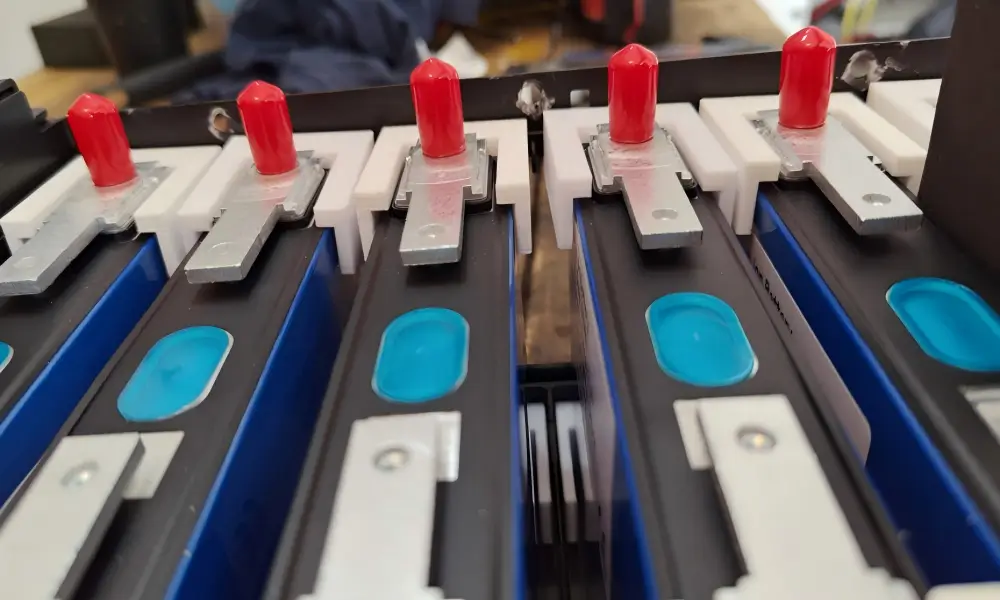
Poor mechanical design is one of the top causes of early pack failure. Follow these rules when building prismatic lithium ion battery modules with M21‑V1.2 cells:
Excessive clamping pressure speeds up cell ageing and shortens cycle life. Always control initial pre-compression force below 4000N per cell.
Do not only monitor bus-bar temperature. Place temperature sensors as close to the cell surface or terminal area as possible for accurate reading and timely protection.
Avoid mixing old, used and brand-new cells inside the same module. Match internal resistance and SOC for every series-parallel group to keep performance balanced.
From Stuart’s retrofit experience: even with top-tier cells, proper CAN-bus system tuning is required to unlock full range potential. Quality hardware alone is not enough — correct system configuration makes the difference.
Proper handling before assembly prevents permanent capacity loss. Follow these lithium cell storage guidelines: • Long-term storage: keep cells at 20-30% SOC, 0-25℃ ambient temperature, and humidity ≤60%RH. • For transport: maintain cell SOC ≤30%. Follow UN38.3 shipping compliance for lithium-ion goods.
Months of high-temperature storage will cause permanent capacity fade, even for brand new unused cells.
Stuart’s EV retrofit project delivered 59km of real driving range after replacing the old battery with EVE M21‑V1.2 cells — a huge jump from the original 18km range. This case highlights three key takeaways for buyers:
This also proves that EV conversion battery packs built with properly configured cells can deliver reliable performance for older EV models.
Steer clear of these common mistakes when sourcing cells for custom battery pack assembly or battery pack OEM projects: • Never copy BMS parameters directly from other cell models — always reference the official M21‑V1.2 datasheet • Do not reuse cells that have gone through over-current or over-voltage events, even if there is no visible damage • Confirm MOQ, sample availability and shipping compliance before placing bulk orders
The EVE M21‑V1.2 59Ah prismatic NMC cell delivers solid energy density, proven by real-world EV retrofit applications. A reliable finished battery pack comes from quality cells combined with proper assembly, correct system setup and adequate safety protection.
Reach out to our team to get the official datasheet, sample quotation or technical support for your custom battery project.
Ready to power your energy systems with the best in the industry?
Contact us today to get the latest pricing and discuss your needs with our team!
